
Connecting Ideas and People — through stories, writing, and activism.
Connecting Ideas and People — through stories, writing, and activism.
25+
YEARS SPEAKING
50+
CAMBODIA TRIPS
100s+
EVENTS WORLDWIDE
For 25 years, Loung Ung has delivered keynote addresses at Stanford, Dartmouth, the United Nations, the Women in the World Summit, and hundreds of universities, corporations, and conferences worldwide. She speaks on resilience, healing, activism, and the power of story to transform lives.
As a child survivor of the Khmer Rouge genocide in Cambodia, I carried those stories inside me for years — a weight that cast a shadow around me wherever I went.
The first time I shared my story with a group of friends, something unexpected happened. They leaned in. They listened. They came up afterward and said, "I didn't know. But now I do. And now I want to do something."
That moment — that shift in a room — is why I have spent 25 years speaking.
I speak because stories are how we find each other across difference. Because the world becomes a little less divided every time one person truly hears another's truth.
This is the truth I bring to every room I am honored to speak in: with honesty, humor, and the deep belief that every person in the audience has their own story worth telling — and their own capacity to heal, to act, and to lead.
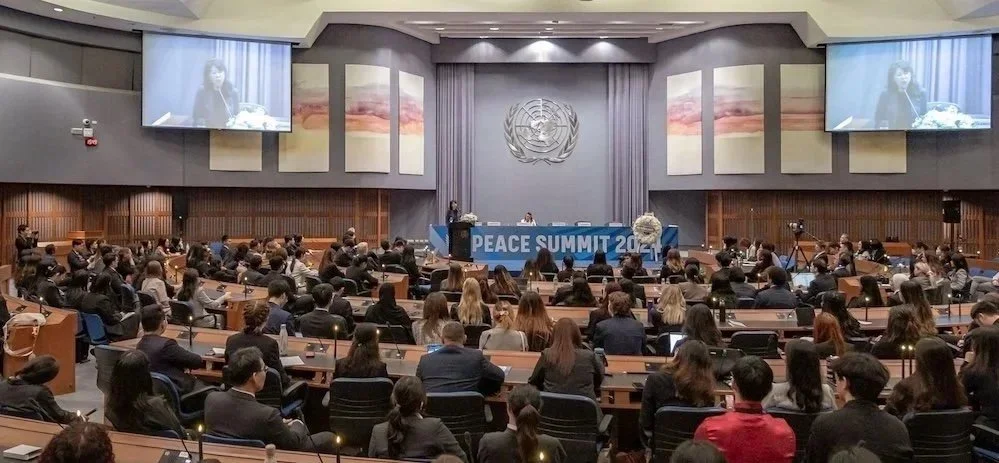
4th Global Peace Summit — Bangkok, Thailand, 2025
What does peace look like for someone who has survived war?
In this keynote address delivered at the 4th Global Peace Summit in Bangkok, Loung brings her singular perspective as a genocide survivor, activist, and storyteller to one of the world's most urgent conversations. Drawing on her childhood in Cambodia and a lifetime of advocacy, she challenges audiences to reimagine resilience — not as the absence of suffering, but as the choice to act in its aftermath.
SATOOK Documentary — Smithsonian National Museum of Asian Art
What does faith look like after genocide?
In this intimate documentary produced for the Smithsonian National Museum of Asian Art, Loung sits down with filmmaker praCh Ly for a conversation about the role Buddhism and faith have played in her healing journey. Moving beyond survival, Loung explores how spiritual practice became her path back to reclaim joy.
One of four conversations with survivors and diaspora of the Khmer Rouge genocide, SATOOK is a film about faith and memory — and about what it means to carry a culture forward through the deepest darkness.
Women in the World Summit — with Angelina Jolie, Loung Ung & Tina Brown
Women in the World founder Tina Brown sits down with director Angelina Jolie and Loung to discuss the making of First They Killed My Father — the Netflix film adaptation of Loung's bestselling memoir, co-written by Loung and directed by Jolie. A rare and candid conversation about storytelling, survival, and the power of bringing one of history's most important untold stories to the world stage.

Before you leave this webpage, I ask this of you.
Today, tonight, tomorrow, tell the person you love that you love them. Never take this ability for granted.
I would give anything to have just another minute with my parents and siblings to say this to them.
When you sit together, take that moment in. Look around the table. See who you love and who loves you — be they your furry family or human family. They are the most important in your world.
And when you leave your home, commit to one thing — one small, beautiful thing — to make this world better. Stand up for someone. Send out a silent prayer for peace. Wish your neighbors well. Unite with a cause.
There are over 1.5 million charitable organizations in this country, populated by people doing good. Find yours. Bake cookies for Girl Scouts. Sing in celebration of survivors. Read to children.
And yet — some of us are not yet privileged enough to have protectors, mentors, and allies. Many of us are in spaces and places where we cannot yet stand for ourselves, raise our voices, or create the change we wish to see. Perhaps it is unsafe. Or too painful. Or we have not yet learned enough.